
Sanding Grit Chart
Sandpaper grit numbers run backwards to what you might expect — the higher the number, the finer the paper — and there are two numbering systems on the shelf. This grit chart lists the common grits with approximate particle sizes and uses, converts between CAMI and FEPA “P” grades, and plans a sanding sequence that removes scratches efficiently instead of wasting time or paper.
- Free to use
- No sign-up
- Runs in your browser
Grit sequence planner
Look up a grit
Sanding Reference Pack
Printable sanding reference: grit chart with uses, CAMI/FEPA conversion card, sanding sequence cards for common jobs and a finishing project log.
- Grit chart (PDF/XLSX)
- Conversion card (PDF)
- Sequence cards (PDF)
- Project log (PDF/DOCX/XLSX)
Formats: PDF, XLSX, DOCX. Instant download after payment (link valid 72 hours, up to 5 downloads). AI-assisted: the templates were drafted with AI help and reviewed and laid out before publishing.
$3.00 USD, one-time 4 files · about $0.75 each
- Instant download
- 7-day refund
- Secure checkout by Stripe
7-day money-back guarantee. Full refund within 7 days of purchase, even after you download.
Free sample: CAMI FEPA Conversion (PDF, 59 KB)
Full refund within 7 days — see the refund policy and license.
Free printables
Single sheets you can print right now, no sign-up. The full pack adds every sheet in one download plus the editable files.
 Printable Sanding Project Log
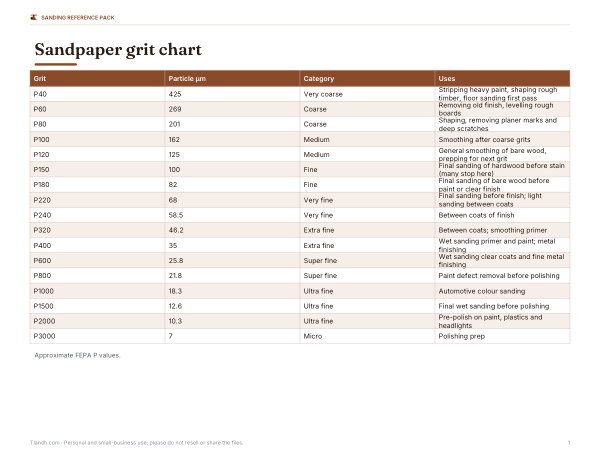
Sandpaper grit chart
| Grit (FEPA P) | Approx. particle size | Category | Typical uses |
|---|---|---|---|
| P40 | 425 µm | Very coarse | Stripping heavy paint, shaping rough timber, floor sanding first pass |
| P60 | 269 µm | Coarse | Removing old finish, levelling rough boards |
| P80 | 201 µm | Coarse | Shaping, removing planer marks and deep scratches |
| P100 | 162 µm | Medium | Smoothing after coarse grits |
| P120 | 125 µm | Medium | General smoothing of bare wood, prepping for next grit |
| P150 | 100 µm | Fine | Final sanding of hardwood before stain (many stop here) |
| P180 | 82 µm | Fine | Final sanding of bare wood before paint or clear finish |
| P220 | 68 µm | Very fine | Final sanding before finish; light sanding between coats |
| P240 | 58.5 µm | Very fine | Between coats of finish |
| P320 | 46.2 µm | Extra fine | Between coats; smoothing primer |
| P400 | 35 µm | Extra fine | Wet sanding primer and paint; metal finishing |
| P600 | 25.8 µm | Super fine | Wet sanding clear coats and fine metal finishing |
| P800 | 21.8 µm | Super fine | Paint defect removal before polishing |
| P1000 | 18.3 µm | Ultra fine | Automotive colour sanding |
| P1500 | 12.6 µm | Ultra fine | Final wet sanding before polishing |
| P2000 | 10.3 µm | Ultra fine | Pre-polish on paint, plastics and headlights |
| P3000 | 7 µm | Micro | Polishing prep |
Particle sizes are approximate averages for the European FEPA “P” scale. Different manufacturers and abrasive types (aluminium oxide, silicon carbide, ceramic) cut differently even at the same grit.
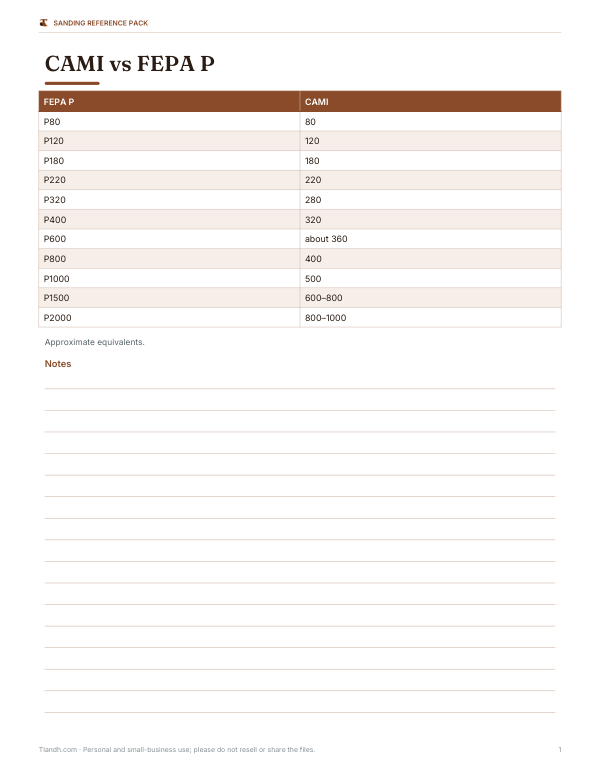
CAMI vs FEPA P grades
| FEPA P | Approx. CAMI (US) |
|---|---|
| P60 | 60 |
| P80 | 80 |
| P120 | 120 |
| P150 | 150 |
| P180 | 180 |
| P220 | 220 |
| P320 | 280 |
| P400 | 320 |
| P600 | about 360 |
| P800 | 400 |
| P1000 | 500 |
| P1500 | 600–800 |
| P2000 | 800–1000 |
Up to about 220 the two scales are close, but above that they diverge: a CAMI 400 paper is roughly as fine as P800. Papers marked with a “P” use FEPA grading; unmarked numbers on US products are usually CAMI. When following a guide, check which scale it means.
How to plan a grit sequence
- Start with the finest grit that removes the defects in a reasonable time — starting too coarse creates extra work.
- Move up in steps no bigger than about double the grit number (for example 80 → 120 → 180).
- Sand until the previous grit’s scratches are gone; pencil marks on wood show when you have covered the surface.
- Stop at the right grit for the finish: over-sanding wood (beyond about 220) can close the grain so stain absorbs unevenly.
- Clean dust off between grits so loose coarse particles don’t scratch.
Worked example
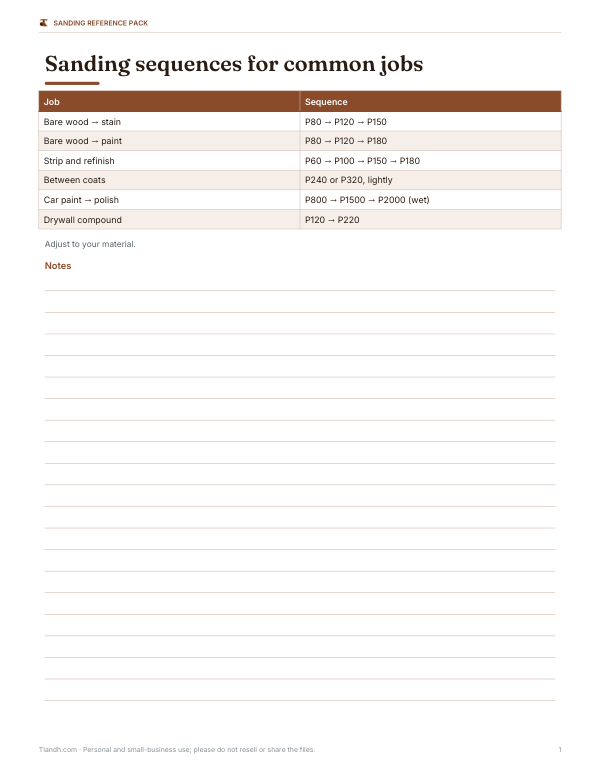
Planed oak boards being stained: the planner suggests P80 → P150, the default for bare wood to stain. With the “thorough” 50% step option it adds an intermediate grit: P80 → P120 → P150. For a car paint repair ready for polishing, it builds P800 → P1500 → P2000 with the typical step, or P800 → P1000 → P1500 → P2000 with the thorough option — the familiar wet-sanding sequence.
Choosing the right abrasive
| Abrasive | Best for |
|---|---|
| Aluminium oxide | Wood and general use; durable |
| Silicon carbide | Wet sanding, paint, plastics, stone; very sharp |
| Ceramic | Heavy stock removal, hardwoods and metal |
| Garnet | Hand sanding fine woodwork; wears quickly |
| Mesh / net abrasives | Dust extraction; resist clogging |
| Sanding sponges | Contours and between coats |
Wet vs dry sanding
Wet sanding with waterproof silicon carbide paper (usually P400 and finer) keeps dust down, stops the paper clogging and leaves a smoother surface — it is standard for car paint, lacquer and some plastics. Use water with a drop of soap as a lubricant and keep the surface wet. Don’t wet sand bare wood, which raises the grain, or water-sensitive finishes.
Hand sanding vs power sanding
| Method | Good for | Tips |
|---|---|---|
| Random orbital sander | Flat surfaces, fast and swirl-free | Let the tool do the work; don’t press hard |
| Detail / mouse sander | Corners and small areas | Finer grits to avoid gouging |
| Belt sander | Heavy stock removal | Keep moving; easy to dig in |
| Sanding block by hand | Final passes, edges, between coats | Sand with the grain on wood |
| Sanding sponge | Curves and mouldings | Rinse to unclog |
On wood, finish by hand with the grain at the final grit to remove any small swirl marks left by power sanders.
Signs of the wrong grit
- Visible cross-grain scratches after staining: a coarse grit was skipped or not fully removed.
- Blotchy stain on softwood: consider a pre-stain conditioner and don’t over-sand end grain.
- Paper clogging quickly: the finish is soft or gummy — use a coarser or open-coat paper.
- Burn marks: too much pressure or a worn belt.
- Glossy spots on primer: sanding too long in one place.
Safety
- Wear a dust mask or respirator rated for fine dust; some wood dusts are sensitisers or carcinogens.
- Old paint may contain lead — test before sanding and follow lead-safe practices if it does.
- Use dust extraction on power sanders.
- Wear eye and hearing protection with power tools.
Privacy
The planner runs in your browser.
Frequently asked questions
Is higher grit sandpaper finer?
Yes — higher numbers mean smaller particles and a finer finish.
What grit should I use on wood before staining?
Usually finish at 150–180; going much finer can make stain absorb unevenly.
What is P in sandpaper grit?
P marks the European FEPA grading scale.
What grit is for wet sanding a car?
Commonly P1000–P2000 before polishing.
Can I skip grits?
Small skips are fine; jumps bigger than about double the grit number leave deep scratches.
What grit removes paint?
Start around P60–P80 for heavy paint removal on wood.
How often should I change sandpaper?
When it stops cutting or clogs — worn paper polishes instead of sanding and slows you down.